
Plumbing Guides
To choose the right plumbing contractor in Kenya, first match the contractor to your project’s scale. Then check for relevant experience, appropriate registration, qualified personnel, a clear written quotation, sound quality-control and testing procedures, strong safety practices and dependable after-installation support. In fact, choosing on the lowest price alone often leads to leaks, blockages, poor water pressure, non-compliant work and expensive repairs later.
Whether you are a homeowner in Nairobi, a developer building apartments, or a facility manager running a hospital or mall, the plumbing contractor in Kenya you appoint shapes how your building performs for years. Therefore, this guide sets out exactly what to evaluate, what to ask, and the warning signs to avoid — with a practical checklist you can use on any project across Kenya and East Africa.
1. Define the project before contacting contractors
First, a clear brief forms the foundation of accurate, comparable quotations. Before you approach any plumbing contractor, write down: whether the project is residential, commercial, industrial or institutional; whether it involves new installation, repair, renovation or maintenance; the building’s size and number of floors; the plumbing and mechanical services required; your expected timeline and any approved drawings or specifications; water-storage and distribution needs, and drainage or wastewater requirements; and firefighting or other integrated mechanical services, if applicable.
Consequently, when every contractor quotes against the same scope, you can compare like with like instead of guessing what each price actually covers.

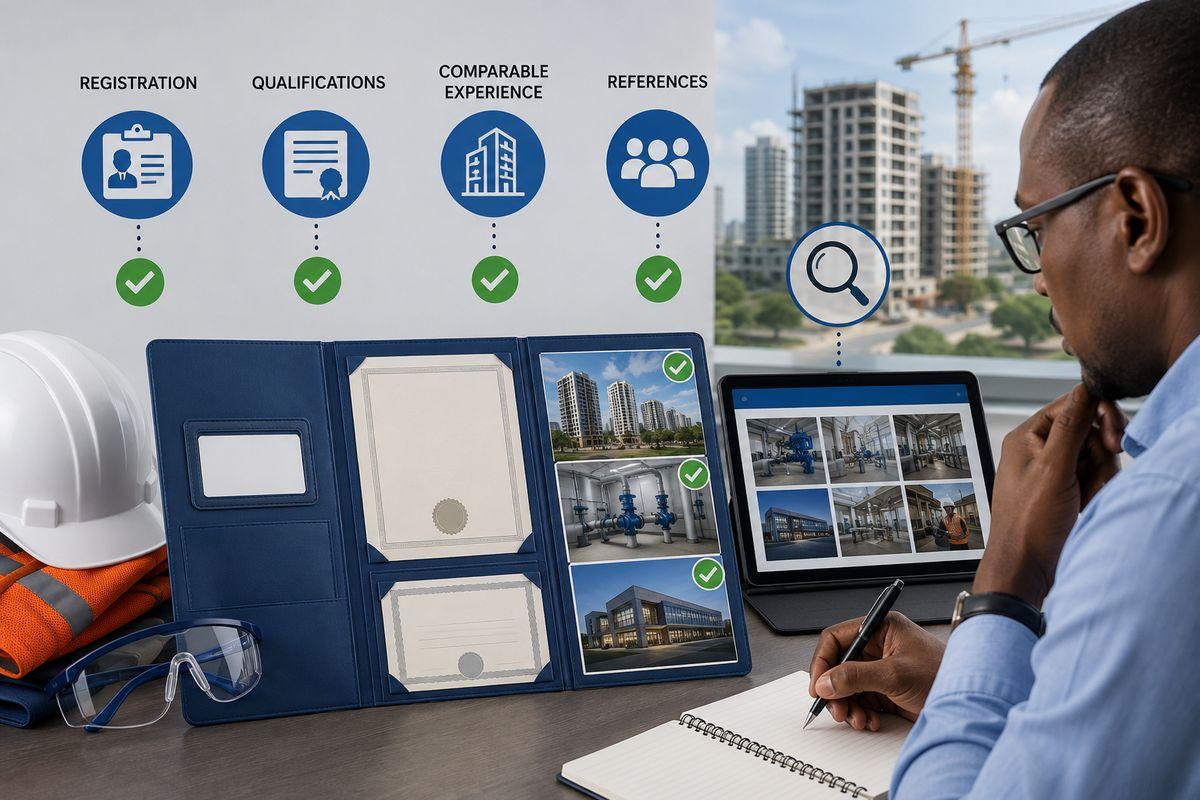
2. Verify registration and qualifications
Next, understand the regulatory landscape. In Kenya, the National Construction Authority (NCA) regulates building works, registers contractors, and categorises them by capacity. For construction and larger installations, confirm: NCA registration and the contractor’s approved category and scope; technical qualifications of the key personnel who will run the job; experience interpreting engineering drawings and specifications; and health-and-safety competence, plus any project-specific approvals.
However, not every job needs the highest category — a minor household repair is not a multi-storey tender. Instead, the contractor’s registration and capacity should match the scale and complexity of your project. For example, Trident Plumbers Limited holds registration as an NCA Category 1 contractor, the classification for undertaking major construction works.
3. Look for relevant project experience
Furthermore, general experience is not enough. For instance, a contractor who has only completed bungalows may struggle on an eight-storey block. Therefore, look for completed projects comparable to yours in building type, height and scale, occupancy, technical complexity, plumbing scope, water demand, drainage requirements, and firefighting or mechanical coordination.
In addition, ask for references, case studies and examples of completed work. Notably, Trident’s verifiable project experience spans multi-storey and institutional developments — including Jomo Kenyatta International Airport (Terminal 4), the Two Rivers and Crystal Rivers developments, hospitals, schools and residential estates — precisely the kind of comparable work worth looking for in any contractor.
4. Evaluate the contractor’s technical capability
Moreover, commercial, high-rise and institutional projects demand far stronger coordination than a household repair. So assess whether the contractor can handle the full range your project needs:
- Plumbing and drainage installation, with correct pipe sizing and material selection
- Water-storage and distribution systems, pumps, valves and pressure control
- External water reticulation and sanitaryware installation
- Firefighting and sprinkler systems, and HVAC and ventilation coordination
- Testing and commissioning, preventive maintenance and emergency repair capacity
Ultimately, a contractor offering integrated mechanical services can coordinate these systems in-house rather than leaving gaps between separate trades.
5. Compare quotations on scope, not price alone
Similarly, a professional quotation is more than a single figure. It should clearly set out:
- Scope of work, materials and specifications, and labour costs
- Equipment requirements, testing and commissioning, and the project timeline
- Payment schedule, exclusions and the procedure for variations
- Maintenance or after-installation support, and applicable taxes
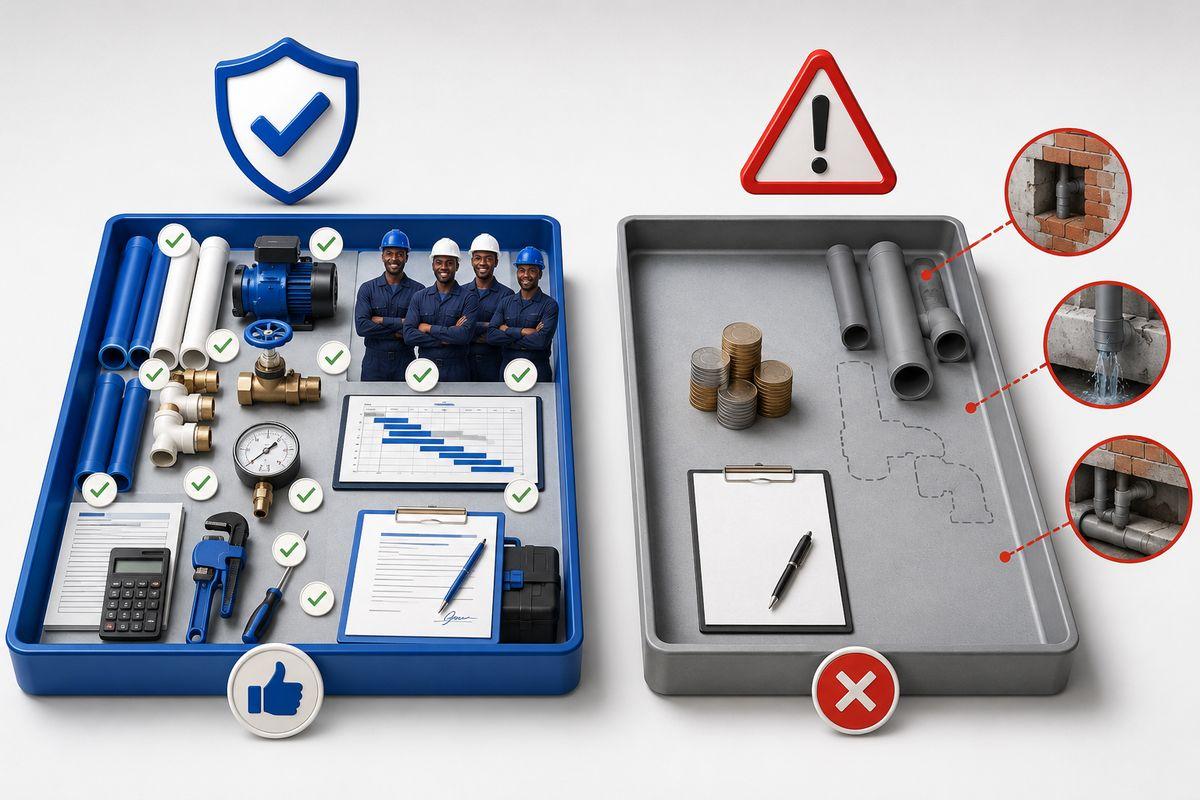
Above all, be cautious of a quotation that sits far below the others. An unusually low price usually signals missing work, unsuitable materials, underestimated labour, or variations that will appear once the job is under way — costing you more than a fair quote would have.
6. Check material quality and specifications
Meanwhile, materials determine how long a system lasts. Verify the proposed pipe types and pressure ratings; the valves, pumps and fittings; the sanitary fixtures and approved manufacturers; and whether components are compatible and suited to the water, pressure and use of your building. Also check that replacement parts are readily available in Kenya and that everything complies with the approved project specifications.
Yet there is no single “best” material for every building — the right choice depends on the system design and operating conditions. That is why an experienced contractor explains its selections rather than simply quoting the cheapest option.
7. Review quality-control and testing procedures
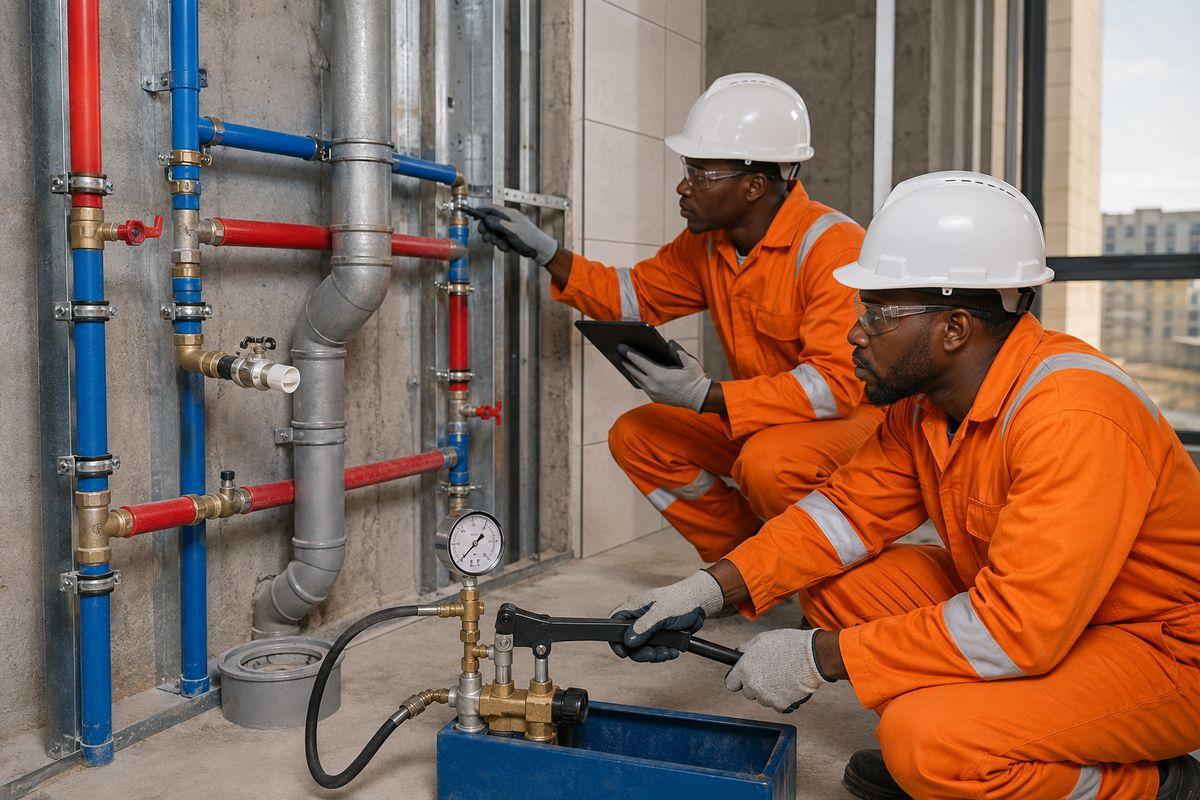
Next, ask how the contractor proves the work is sound before it is hidden. Specifically, a credible process includes inspection of concealed work, pressure testing, leak and drainage testing, flushing, commissioning, defect correction, as-built drawings and proper handover documentation.
Timing is everything. Testing must happen before pipes are concealed behind walls and slabs or the building is occupied. Discovering a leak after tiling — or after tenants move in — is far more disruptive and expensive to fix.
8. Evaluate safety practices
Additionally, plumbing work involves heights, excavations, confined spaces and sometimes hot works. So a responsible contractor uses personal protective equipment, provides site supervision, works safely at height, controls excavation and confined-space risks, protects occupants and other trades, keeps the site tidy and reports incidents properly. Indeed, poor safety on site is a reliable indicator of poor workmanship elsewhere.
9. Consider communication and project management
Likewise, on a live construction site, communication prevents costly mistakes. Therefore, the contractor should give you a responsible project contact, regular progress updates and clear documentation, coordinate with consultants and other trades, flag delays or variations early, respond promptly to site instructions, and follow proper snagging and handover procedures.
10. Ask about warranties, maintenance and after-installation support
Furthermore, good plumbing does not end at handover. Clarify in writing the workmanship guarantees offered, the manufacturer warranties on equipment, defects-liability responsibilities, emergency-response arrangements, spare-part availability, preventive-maintenance services and post-handover inspections. Ultimately, a contractor that stands behind its work and offers ongoing maintenance protects your investment long after the project completes.
11. Check references and completed projects
Then verify claims before you sign. Practical steps include:
- Speaking with previous clients about their experience
- Visiting completed projects where possible, and reviewing project photographs
- Asking how delays, variations and defects were handled
- Confirming the contractor actually completed the full scope it stated
12. Warning signs when hiring a plumbing contractor in Kenya
On the other hand, walk away — or ask hard questions — if you see:
- Refusal to provide a written quotation, or unverifiable registration
- No comparable project experience and vague material specifications
- Extremely low prices, or large unexplained upfront-payment demands
- No testing or commissioning plan, and poor communication
- No written agreement, unsafe working practices, or reluctance to give references
- No maintenance or after-installation support
13. Questions to ask before hiring a plumbing contractor
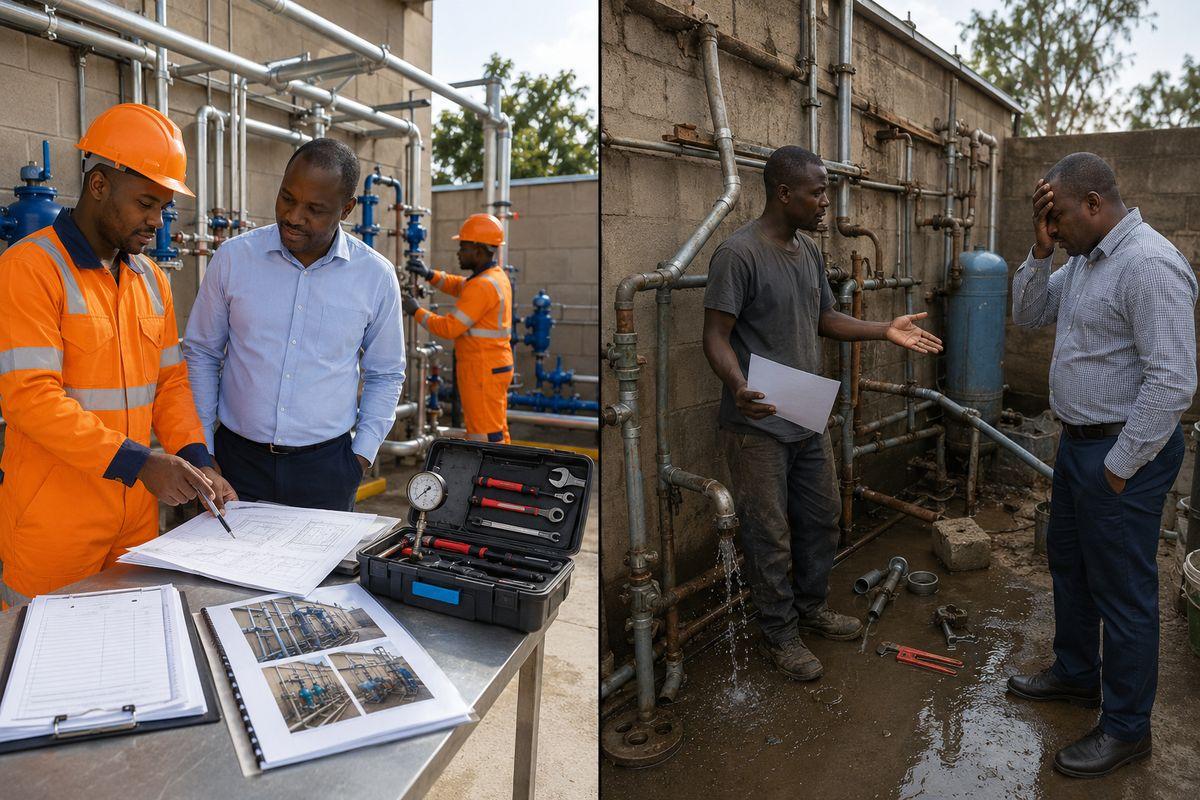
Meanwhile, a short conversation reveals a great deal. So put these questions to any contractor on your shortlist:
- Have you completed projects similar to mine?
- What registration and qualifications do you hold?
- Who will supervise the work on site?
- Which materials and systems are included in your quotation?
- How will testing and commissioning be carried out?
- What is excluded, and how are variations handled?
- Can you provide recent references?
- What documentation will I receive at handover?
- What support is available after completion?
14. Why experience matters on commercial and complex projects
Finally, hospitals, schools, airports, hotels, factories, malls, offices and high-rise developments are unforgiving of weak plumbing. In particular, they demand greater system reliability, stronger coordination between trades, careful pressure and water-distribution planning, firefighting integration, detailed testing, documented handover and planned maintenance. On projects like these, a contractor’s depth of relevant experience is not a luxury — it is what keeps the building running and its occupants safe.
Plumbing contractor in Kenya: selection checklist
In short, use this checklist to score any plumbing contractor before you appoint them.
| Selection criterion | What to verify | Warning sign |
|---|---|---|
| Registration | NCA registration and category suit the project scale | Cannot show or confirm registration |
| Relevant experience | Comparable building type, scale and scope completed | Only unrelated or much smaller jobs |
| Technical personnel | Qualified supervisor and skilled team named | Unclear who runs the work |
| Written scope | Detailed, itemised quotation and scope | Verbal or one-line pricing |
| Materials | Named types, ratings and manufacturers | Vague or unspecified materials |
| Testing | Pressure, leak and drainage tests before concealment | No testing or commissioning plan |
| Safety | PPE, supervision and site controls in place | Unsafe or untidy site practices |
| References | Reachable past clients and visitable projects | Reluctant to provide references |
| Timeline | Realistic programme with milestones | Unrealistic promises or no dates |
| Maintenance support | Warranty, defects cover and maintenance offered | No after-installation support |
How Trident Plumbers Limited measures up
Trident Plumbers Limited is a Kenyan plumbing and mechanical-services contractor — the kind of plumbing contractor in Kenya that this guide recommends — established in 1988 and incorporated in 1993, and it holds registration with the National Construction Authority as an NCA Category 1 contractor. In short, that combination of long track record and top registration category speaks directly to the experience and capacity criteria above.
Moreover, the company provides integrated services relevant to residential, commercial, industrial and institutional projects: plumbing and drainage installation, water-supply and external reticulation, water-storage and distribution systems, sanitaryware installation, firefighting and sprinkler systems, air-conditioning and ventilation, solar water-heating, commercial boiler installation, and preventive maintenance and repairs. Notably, its verifiable project experience — from Jomo Kenyatta International Airport (Terminal 4) to the Two Rivers and Crystal Rivers developments, hospitals, schools and residential estates — represents the kind of comparable, checkable evidence this guide recommends every client should request.
Talk to Trident about your project
For residential and commercial plumbing, plumbing and drainage installations, water-storage and distribution systems, firefighting systems, mechanical installations, inspections, repairs, preventive maintenance or large construction projects, Trident Plumbers Limited can help. Share your scope for a clear, itemised quotation.
Call +254 110 444 333 | Email info@tridentplumbers.com | tridentplumbers.com
Trident Plumbers Limited · Astral Plaza, Old Mombasa Road, Kyang’ombe, Nairobi, Kenya
Tel: +254 110 444 333 / +254 020 2081501
In conclusion, choosing a plumbing contractor should rest on competence, relevant experience, proper registration, quality-control procedures and long-term support — not price alone. So use the checklist above, ask the right questions, and appoint the contractor who can prove they will still stand behind the work years after handover.
Regulatory reference: National Construction Authority (NCA). Contractor registration requirements vary with the scale and category of works; confirm the current requirements for your specific project.