
Solar Water Heating in Kenya: Is It Worth the Investment?
Renewable Energy & Mechanical Services
For many Kenyan property owners, solar water heating in Kenya raises the same practical question: it needs money upfront, so will it pay off? A well-designed system can cut long-term reliance on electricity or LPG for hot water — but the honest answer is that its value depends on the building, how much hot water it uses, how the system is designed, and how well it is installed and maintained.
Solar water heating is generally worth the investment in Kenya when a building has consistent, predictable hot-water demand, enough well-oriented roof space and sunlight, a correctly sized system, and professional installation. Its financial value rests on the installation cost, current energy use, occupancy and how much conventional electricity or fuel it can realistically replace — so it is not automatically the right choice for every property.
Quick answer: is solar water heating worth it in Kenya?
In most cases, yes — but conditionally. Solar water heating is usually most attractive where hot-water demand is frequent and predictable: homes with larger families, apartment blocks, hotels and lodges, hospitals, boarding schools, gyms, laundries and staff facilities. In those settings a system can replace a large share of the energy otherwise spent heating water.
The case weakens where hot-water use is very low, the roof is shaded or poorly oriented, the system is undersized or oversized, or the installation is done poorly. In short, solar water heating rewards the right building and the right design — not simply the decision to buy a tank.
What is solar water heating and how does it work?
A solar water heating system uses the sun’s heat to warm water directly. It is not the same as photovoltaic (PV) solar panels, which generate electricity. Solar thermal collectors capture heat; PV panels make power. This article is about solar thermal.
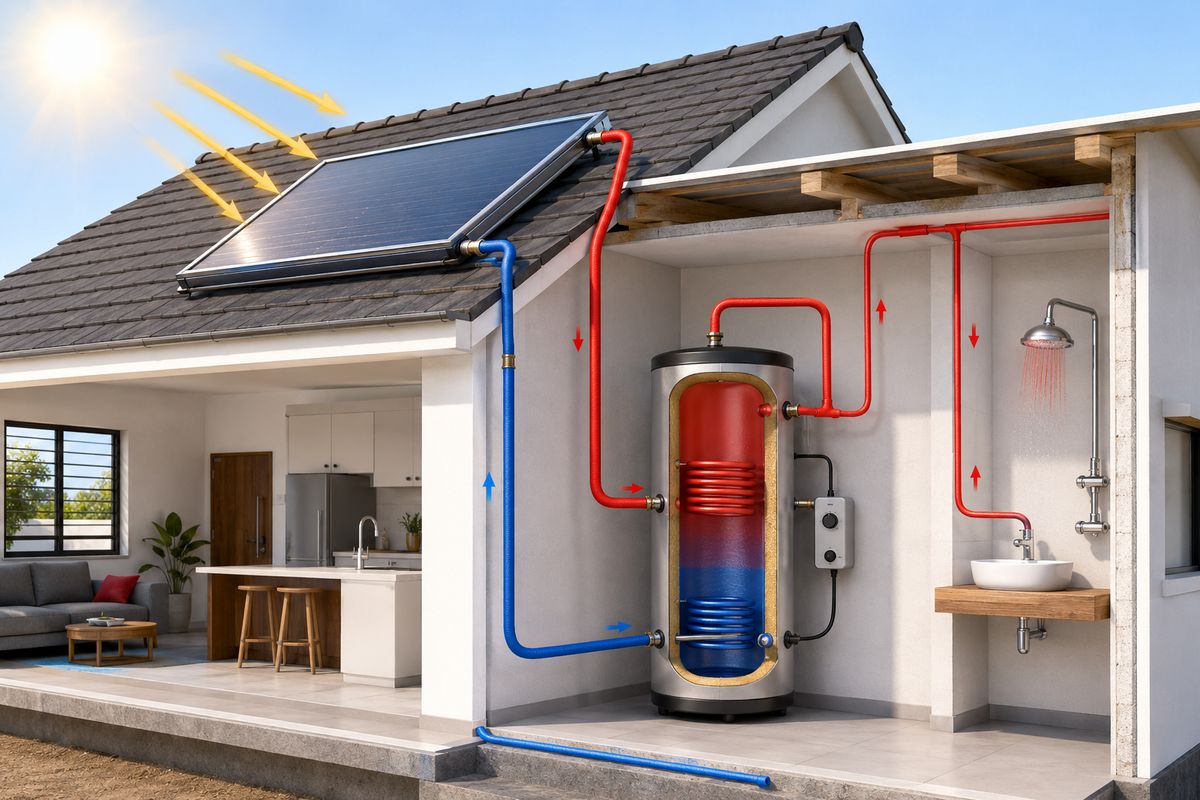
A typical system has:
- Solar thermal collectors — roof-mounted flat-plate or evacuated-tube panels that absorb heat from sunlight.
- An insulated hot-water storage tank that holds the heated water.
- Insulated pipework connecting collectors, tank and fixtures to limit heat loss.
- Circulation — either natural (thermosiphon, where hot water rises without a pump) or pumped (an active system for larger or split layouts).
- Temperature and pressure controls and safety valves.
- Conventional backup heating (usually electric) for cloudy spells and peak demand.
Heated water is then delivered to taps, showers and other fixtures. Because Kenya enjoys strong, year-round solar radiation, solar thermal systems can meet a substantial part of a building’s hot-water needs — though a backup remains necessary for reliability.
What determines the cost of solar water heating in Kenya?
There is no single price for a solar water heater in Kenya, because cost is driven by the building and its demand rather than by one product. The main factors are:
- Required hot-water capacity, and daily occupancy and usage patterns
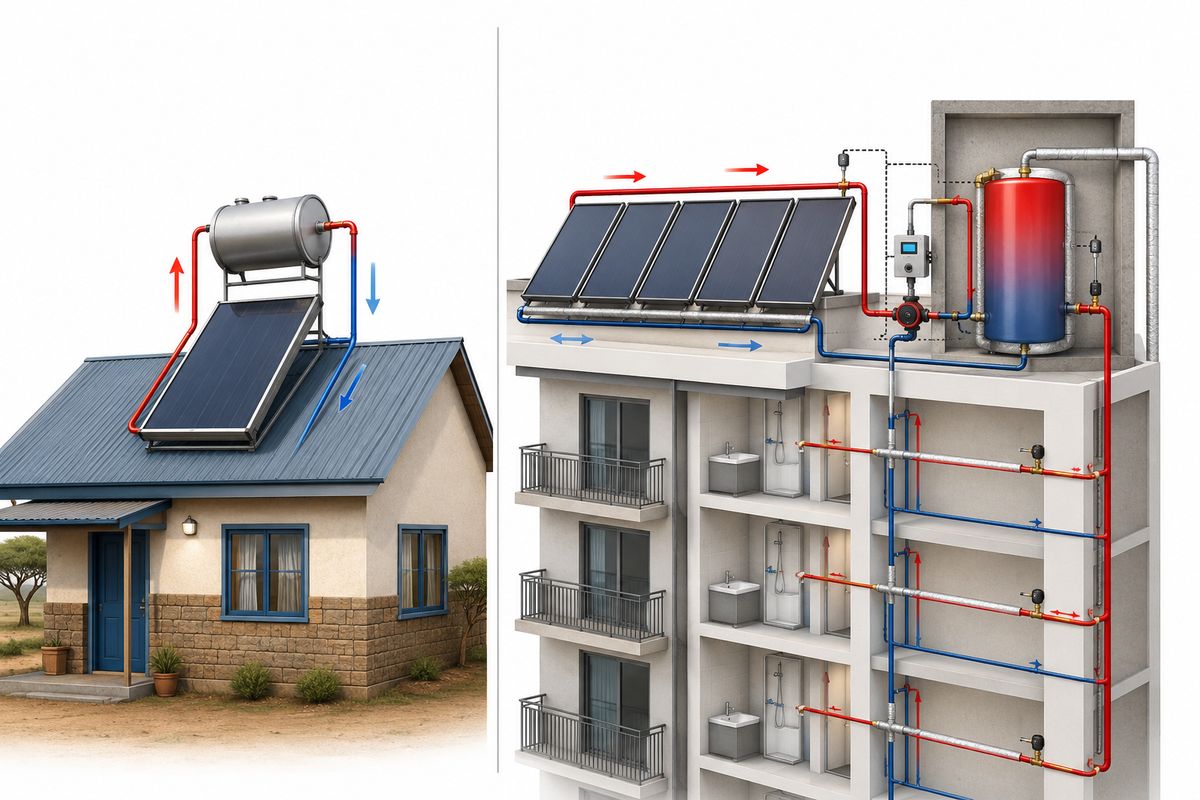
- Whether the system is standalone (per unit) or centralised (serving a whole block)
- Collector type — flat-plate versus evacuated-tube
- Circulation type — thermosiphon versus pumped
- Storage-tank size and quality of insulation
- Roof structure, orientation and shading
- Pipe distances between collectors, storage and fixtures
- Modifications needed to existing plumbing
- Water pressure and water quality (hard water affects component choice)
- Backup-heating requirements, controls, valves and safety equipment
- Installation complexity and access for future maintenance
This is why a credible contractor prepares a quotation only after a site assessment — a price quoted before anyone has seen the roof, the demand and the existing plumbing is a guess, not an estimate.
How does solar water heating save money?
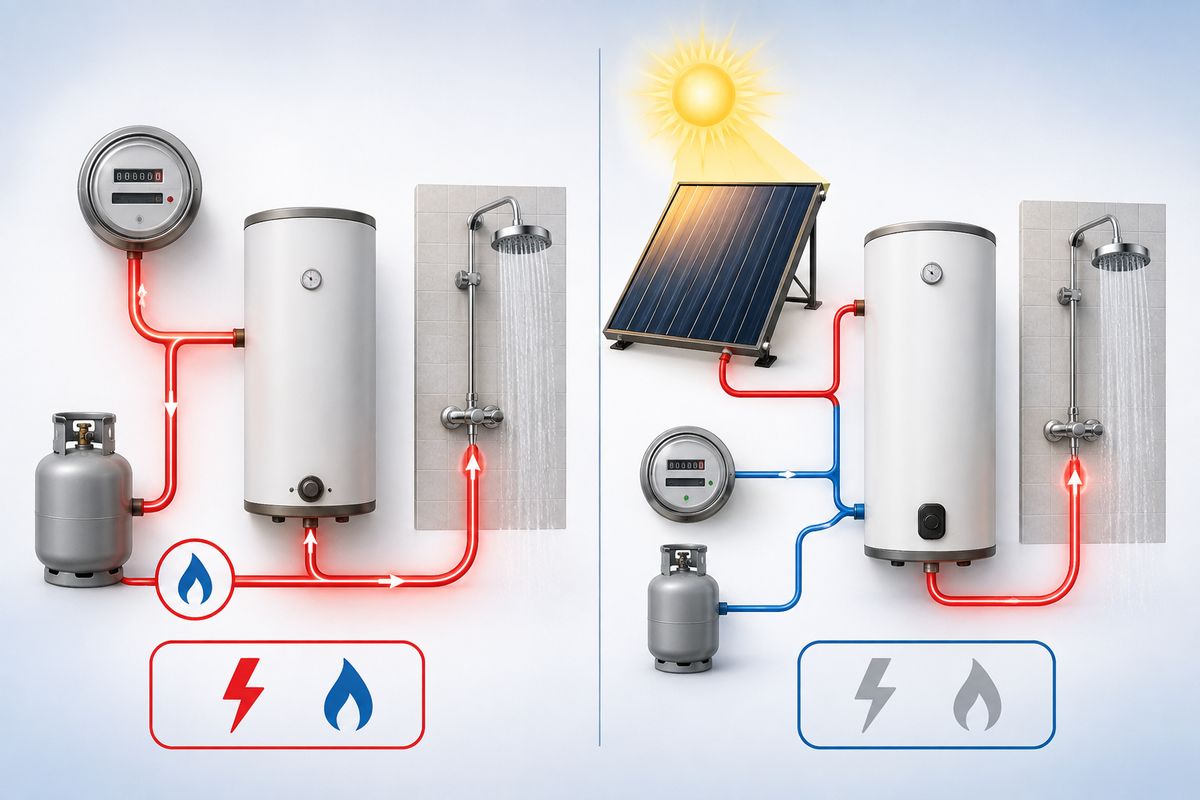
Savings come from replacing part of the electricity, LPG or other fuel normally used to heat water. The more hot water a building uses — and the more expensive its current heating — the greater the potential saving. Actual results depend on the volume of hot water used, the existing heating method, energy tariffs, solar exposure, system efficiency, insulation, user behaviour, maintenance condition and how often the backup heater runs.
A simple way to think about the return:
Illustrative method — not a quotation or guarantee
Annual net saving = annual conventional water-heating cost avoided − annual solar operating and maintenance cost.
Estimated payback period = total installed cost ÷ estimated annual net saving.
For example, if a property currently spends a certain amount each year heating water electrically, and a correctly sized solar system is expected to cover most of that demand, the avoided electricity cost (less modest maintenance) gives the annual net saving; dividing the installed cost by that figure gives an approximate payback. The precise numbers depend entirely on your building’s demand, tariff and system — which is why any payback figure should be treated as an estimate based on stated assumptions, not a promise.
Which Kenyan buildings benefit most?
Buildings with steady, high hot-water demand tend to gain the most. The table below is a general guide — suitability for any specific property should always be confirmed by a site assessment.
| Building type | Typical hot-water demand | Potential suitability | Key design consideration |
|---|---|---|---|
| Private homes | Low to moderate; peaks morning/evening | Good for larger families | Match tank size to household routine |
| Apartment blocks | Moderate to high; many units | Strong | Standalone vs centralised design |
| Hotels & lodges | High and continuous | Very strong | Peak-occupancy timing and backup |
| Hospitals & clinics | High; reliability critical | Strong | Guaranteed delivery temperatures |
| Boarding schools & colleges | High; concentrated peaks | Very strong | Large storage for morning demand |
| Restaurants & commercial kitchens | High; hot cycles | Strong | Temperature and volume needs |
| Gyms & staff facilities | Moderate to high; shower peaks | Good | Sizing for peak shower periods |
| Laundries | Very high; sustained | Very strong | Collector area and recovery rate |
What are the main benefits?
- Reduced reliance on conventional water-heating energy
- Lower exposure to rising or fluctuating energy costs
- Use of a renewable resource Kenya has in abundance
- Reliable hot-water availability when the system is correctly designed and backed up
- Reduced environmental impact and a stronger building sustainability profile
- Particular value for high-demand residential and commercial properties
- Long-term value when installation and maintenance are done professionally
When might solar water heating not be worth it?
Being candid about the limits protects your investment. Solar water heating may not deliver a strong return where:
- Hot-water demand is very low
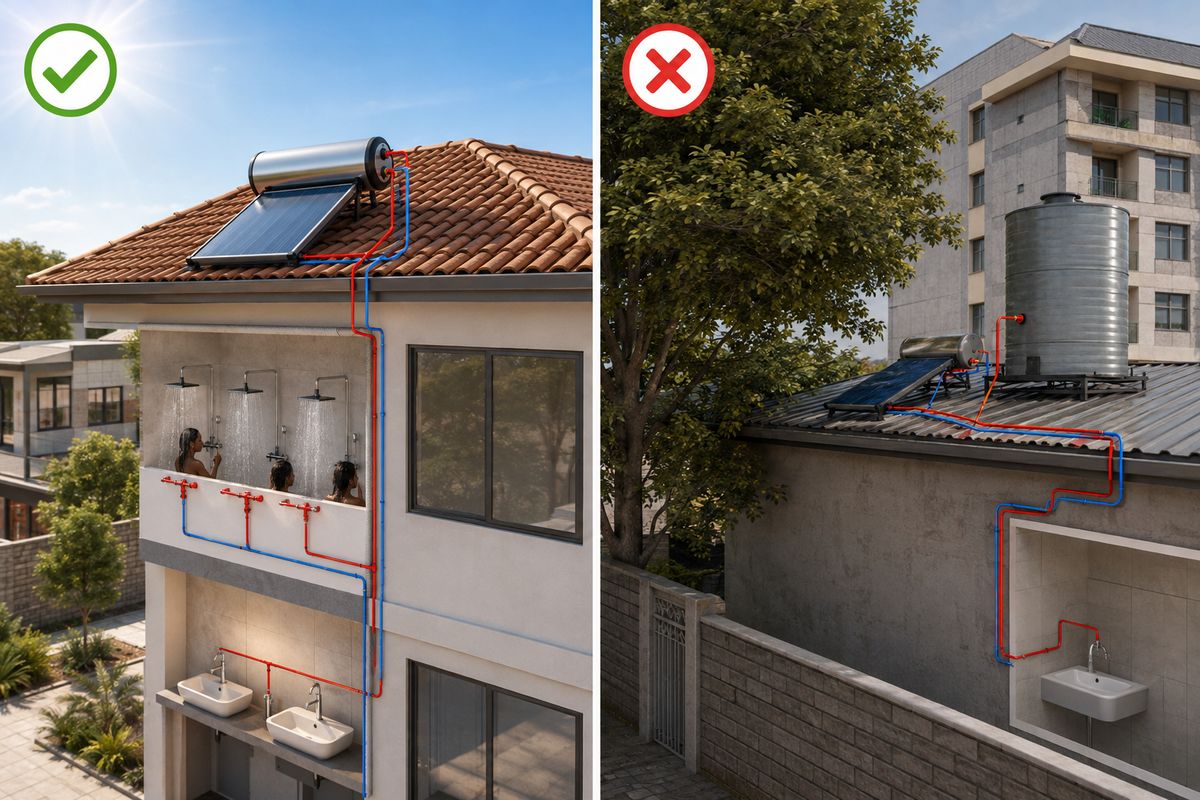
- The roof is heavily shaded, poorly oriented, or lacks installation space
- The building is due for major structural changes
- Pipe runs are excessive, causing significant heat loss
- The system is incorrectly sized — too small to meet demand or too large to be efficient
- Poor-quality components or unqualified installation undermine performance
- Maintenance is neglected
- There is an unrealistic expectation that solar removes every backup-heating cost — it reduces it, but a backup is still needed
What do Kenya’s solar water-heating regulations require?
Solar water heating in Kenya is now governed by the Energy (Solar Water Heating) Regulations, 2025 (Legal Notice No. 115 of 2025), which commenced on 9 July 2025 and are administered by the Energy and Petroleum Regulatory Authority (EPRA). This is not legal advice; confirm how the rules apply to your project with a qualified professional.
In broad terms, the current regulations provide that:
- New premises must make provision for a solar water heating system in their design. County governments are expected to enforce this when approving architectural and engineering designs.
- Responsibility for compliance is shared among developers, promoters, owners, architects, engineers and contractors involved in the design or construction.
- Only licensed persons may install, test, commission, maintain or repair solar water heating systems, under EPRA worker and contractor licensing classes (for example, worker classes for standalone and for centralised systems).
- Systems must meet applicable Kenya Standards, the Building Code, and health, safety and environmental requirements.
The 2025 regulations also set a sizing benchmark: the storage capacity of a solar water heating system should be at least one and a half times the installation’s daily hot-water demand. Note that this replaces the older 2012 rule that applied only to premises using more than 100 litres of hot water per day — the current framework is broader.
For the authoritative text, see Kenya Law, the Energy and Petroleum Regulatory Authority and the Ministry of Energy and Petroleum. Product and installation standards are published by the Kenya Bureau of Standards (KEBS).
How should a solar water-heating system be sized?
Correct sizing is where the financial case is won or lost. Capacity should be based on:
- Number of occupants or users, and daily hot-water demand
- Peak-use periods (a boarding school’s morning rush, a hotel’s evening peak)
- Building type and required delivery temperatures
- Collector area and storage capacity
- Seasonal weather and cloud cover
- Backup-heating strategy
- Likely future growth in occupancy
As a reference point, the 2025 regulations base demand on building use — for example, an allowance per person for residential premises and per bed for hospitals — with storage of at least 1.5 times daily demand. The practical lesson: never choose a system on tank capacity or purchase price alone. An undersized system disappoints; an oversized one wastes money.
Why does professional installation matter?
Even good equipment underperforms if it is installed badly. Poor installation can lead to inadequate heating, heat loss through uninsulated pipes, roof leaks, incorrect pressure control, unsafe water temperatures, corrosion, leaking joints, poor circulation, excessive backup-electricity use, difficult maintenance access and a shortened system life.
Professional installation adds value through proper site assessment, hydraulic design, correct component selection, pressure testing, commissioning and a planned maintenance regime — and, under the 2025 regulations, must be carried out by licensed personnel.
How much maintenance does a solar water heater need?
Solar water heaters are low-maintenance, not maintenance-free. Sensible upkeep includes:
- Checking collectors for dirt, shading or damage, and inspecting pipe insulation
- Testing valves and controls, and checking for leaks
- Assessing the storage-tank condition and, on active systems, inspecting pumps
- Monitoring water temperature and overall performance
- Managing scale in hard-water areas, and servicing the backup heater
Regular maintenance protects both performance and the return on your investment. You can see how we approach this across completed installations.
A practical investment checklist
Before committing, work through these questions:
- How much hot water does the property actually use?
- What does it currently spend on water heating?
- Is the roof structurally suitable and sufficiently exposed to sunlight?
- How far will heated water travel to the fixtures?
- Is the system correctly sized for demand?
- What backup system is required?
- Are compliant, good-quality components being used?
- Who will install and commission the system, and are they licensed?
- What maintenance support is available afterwards?
- What assumptions sit behind the payback estimate?
Conclusion: is it worth it?
Solar water heating in Kenya can be a worthwhile long-term investment — especially for buildings with consistent, high hot-water demand such as apartments, hotels, hospitals, schools and laundries. But it is not universally worthwhile: its success depends on professional assessment, correct sizing, quality components, compliant installation and ongoing maintenance. Treated as an engineered system rather than an off-the-shelf purchase, it can reduce energy costs for years; treated as a box to tick, it can disappoint.
Find out if it’s worth it for your building
Trident Plumbers Limited — established in 1988 and an NCA Category 1 contractor — designs, sizes, installs and maintains solar water-heating systems for homes, apartments and commercial and institutional buildings. Get a site assessment and an honest, building-specific recommendation.